
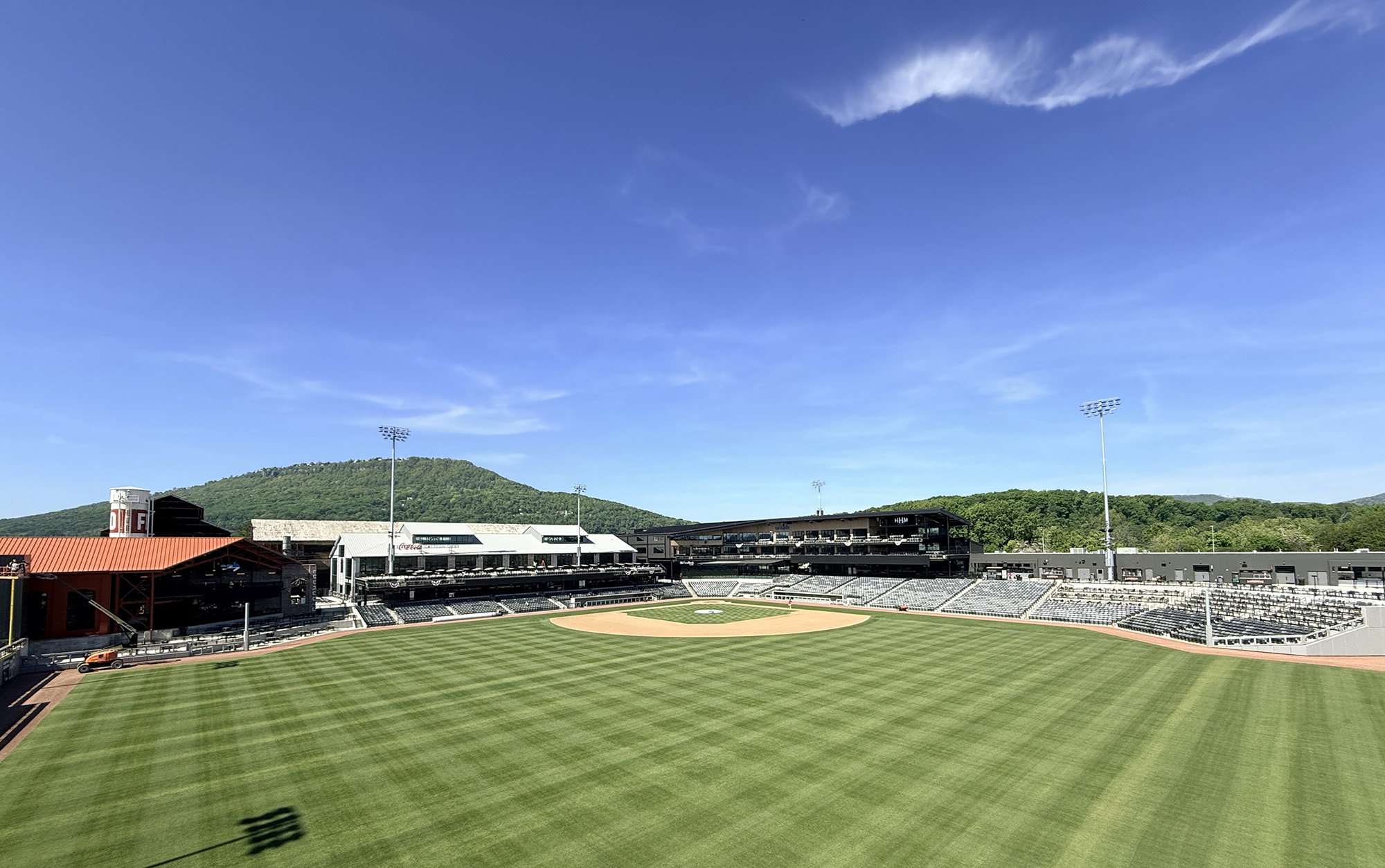
With the opening of Erlanger Park, the Chattanooga Lookouts (Double-A; Southern League) have significantly advanced the art of ballpark design, bringing new life to a historic industrial site while providing a unique experience for both fans and players.
In the long history of Chattanooga professional baseball, the Lookouts have called many ballparks home—including Montgomery’s historic Cramton Bowl in a wartime season—but since 1930 the team has played mainly in three venues: Engel Stadium, AT&T Field and now Erlanger Park. Engel Stadium—still standing, though decaying and neglected—is one of the most historic venues in all of baseball (perhaps only second to Rickwood Field in legacy importance), so any new ballpark in Chattanooga has a tremendous legacy to acknowledge.
Erlanger Park, happy to report, lives up to that legacy thanks to the most unique design among Minor League Baseball ballparks. The ballpark is located on the southwestern edge of downtown Chattanooga, in the shadow of Lookout Mountain, at the former foundry home of Wheland Foundry and U.S. Pipe.
According to the University of Tennessee-Chattanooga, U.S. Pipe and Foundry Company was founded in 1887 and opened its South Broad plant in Chattanooga in 1936, joining the Wheland Foundry, which launched Chattanooga operations in 1873. The Wheland Company closed down foundry operations in 2002, with U.S. Pipe ceasing operations in 2006; since then, the owners, the Chazen family, sought an appropriate adaptive reuse plan for a desirable, high-profile plot of land. (See here for a look at the site before the Lookouts ballpark work began.) The 140-acre site off South Broad Street is highly visible from I-24—indeed, the ballpark is just a stone’s throw from the interstate and the Tennessee River—and the temptation would have been for the site to be sold to a developer who would keep some old buildings as window dressing and raze the rest.
But that would have been an unimaginative approach to such a historic site, literally in the shadow of Lookout Mountain. An appropriate adaptive reuse of the site has been the goal of the city and ownership for years. Freier had been seeking a new home for the Lookouts since 2015, a process accelerated by MLB’s takeover of MiLB and subsequent quest to update ballpark standards, and after meetings with city and Hamilton County officials, the three parties settled on a reuse plan for the foundry. A Sports Authority was created to issue bonds toward the new $120-million ballpark, with the Lookouts pledging a million dollars per year (and rising annually) in rent, with the bonds backed by the proceeds of increased property tax payments (based on rising property values) in the South Broad District and sales taxes generated by the ballpark.
“This is the gateway to Chattanooga, how many first see the city,” said Lookouts owner Jason Freier on an Opening Day tour of the new ballpark. “We felt we needed to do something special here.”
And they did. While there was plenty of open land in the area perfectly suitable for a new MiLB ballpark, Freier and his design team—Mike Sabatini, now retired but a former architect with Populous with plenty of MLB and MiLB work on his resume, worked on the baseball side; New York-based S9 oversaw the historic-preservation side—didn’t run away from the site’s industrial past, but directly embraced it with a ballpark nestled into the most historic core of the Foundry District, including the actual foundry, power facility and finishing facility.
In fact, it’s almost as if Freier and the design team purposely chose the most challenging location at the old foundry for a ballpark, a footprint hemmed in by the edge of the property to the west, the Tennessee Riverwalk and Chestnut Street to the east.
The gamble paid off.
Freier has experience placing ballparks in the midst of historic sites. Segra Park, opening in 2016 as home of the Columbia Fireflies (High-A; Sally League), is nestled within the existing buildings of the 181-acre site formerly housing the South Carolina state hospital for the mentally ill. The site was deeded to the city as a place to treat and house the mentally ill, and over the years it grew into a self-contained campus, surrounded by a growing city.
Some of the existing hospital buildings were built into the ballpark—including the former morgue—but the centerpiece at Segra Park was a new office building opening onto the ballpark, offering a premium deck experience.
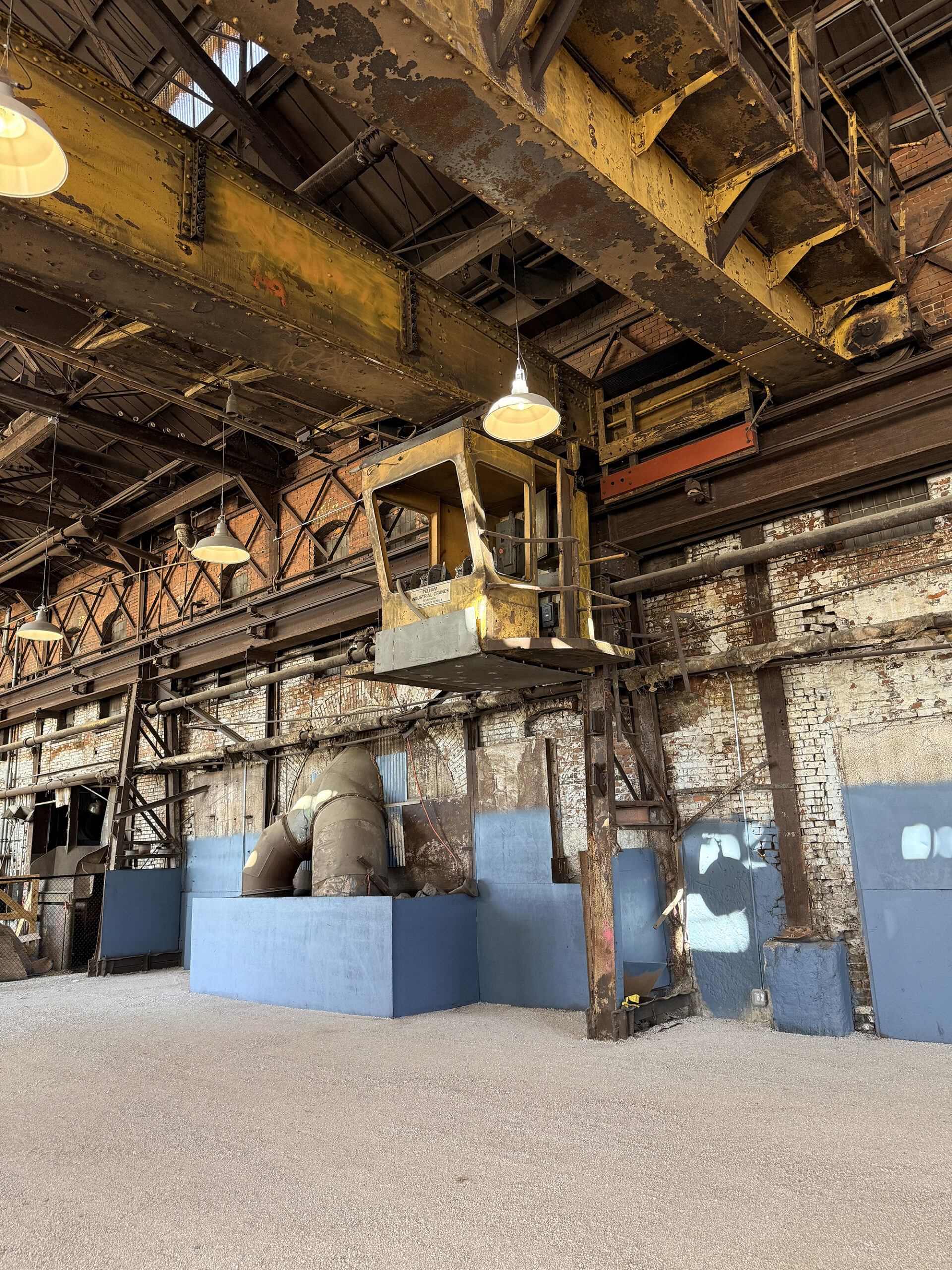
In Chattanooga, there is still new construction central to the ballpark experience, but the adaptive reuse angle is embraced and emphasized. For starters, there’s the adoption of the actual foundry in the mix (shown above, complete with the tools of the trade), a multistory behemoth that Freier foresees as a group space. Constructing anything within the building would be a challenge, as would taking it down (the foundry is built like a battleship, featuring thick walls and a one-inch-thick iron roof), so the design team took an unusual approach to placing a store and storage there: the frame of a modern team store was built offsite and slid directly into the existing building frame.
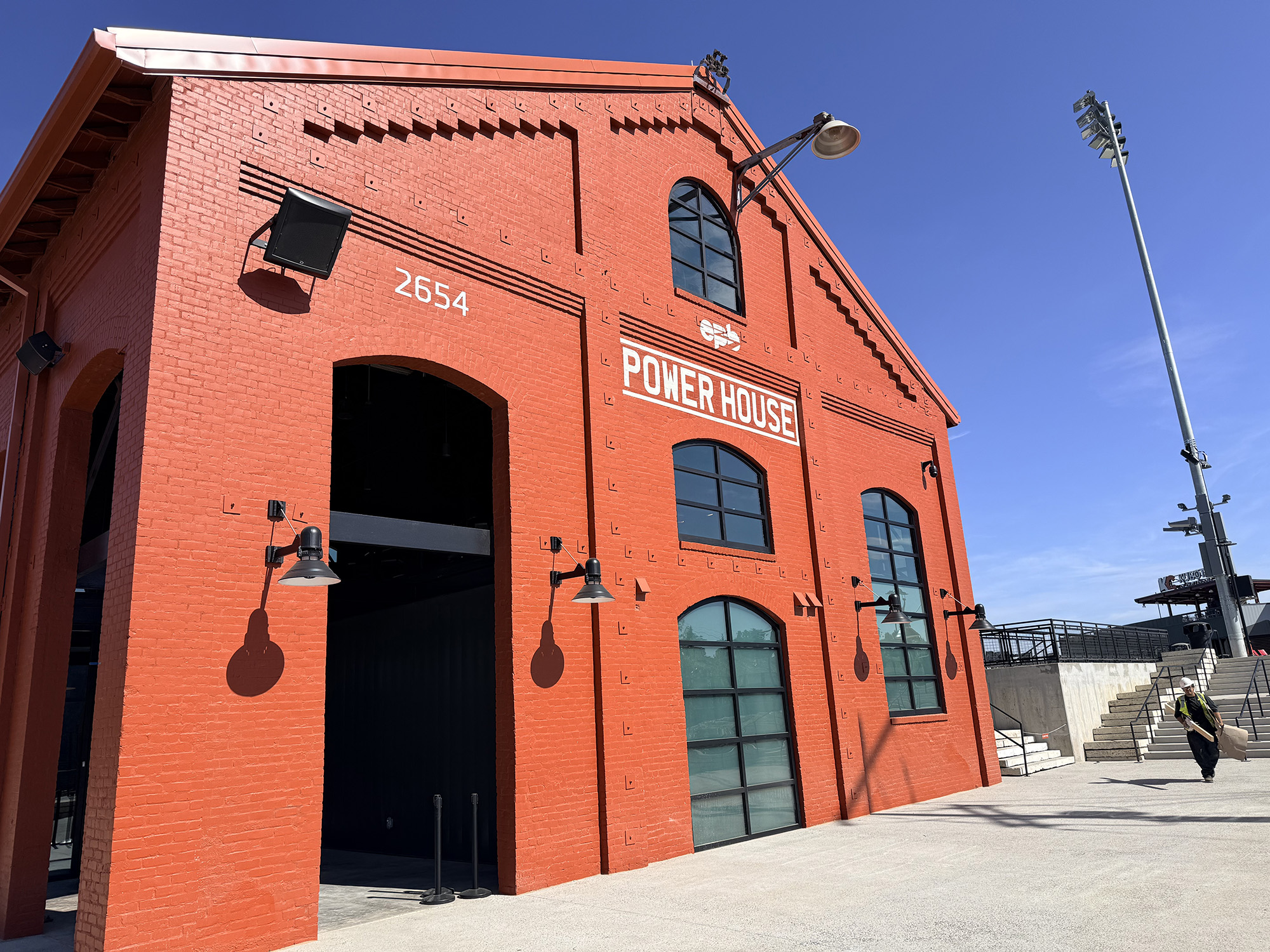
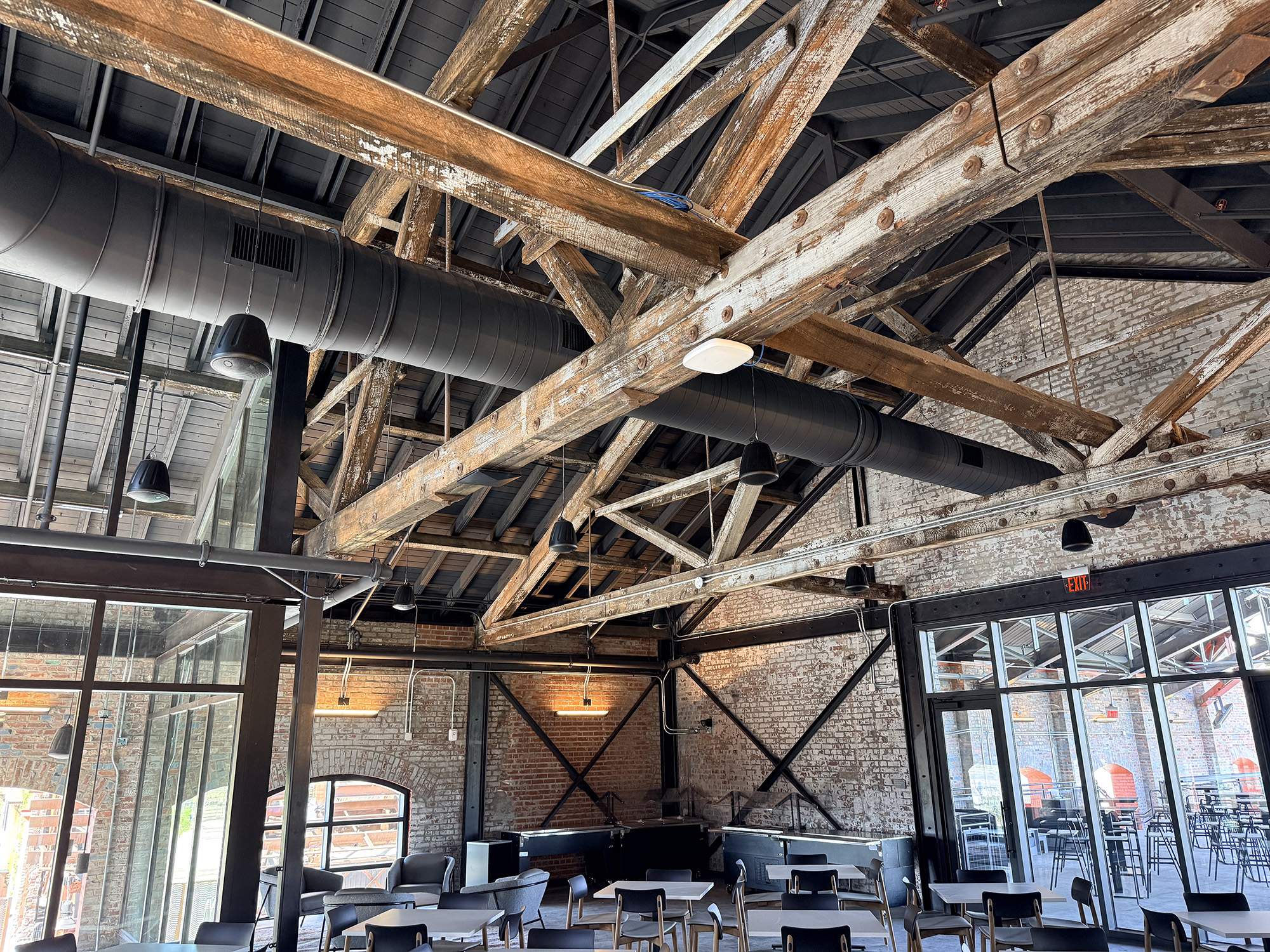
Similarly, the old power plant was repurposed into a two-story group area in the right-field corner, the EPB Powerhouse. There are some historic elements installed in this space, combining an indoor club/group 4,000-square-foot space with plenty of tiered, covered table seating and an additional 3,000 square feet tiered deck space. This building was altered during the conversion, including the installation of a new roof, and in the process a brick wall collapsed. In the reconstruction of the wall, a happy accident ensued: the brick wall was rebuilt using bricks from the old wall as well as elsewhere in the complex. The ensuing brick wall features a multicolored mosaic, including bricks painted with the Foundry Blue hue found throughout the grounds. There is a delightful interplay between the interior support beams, brick walls and architectural elements with the modern furnishings and the multilevel seating terrace leading to the playing field.
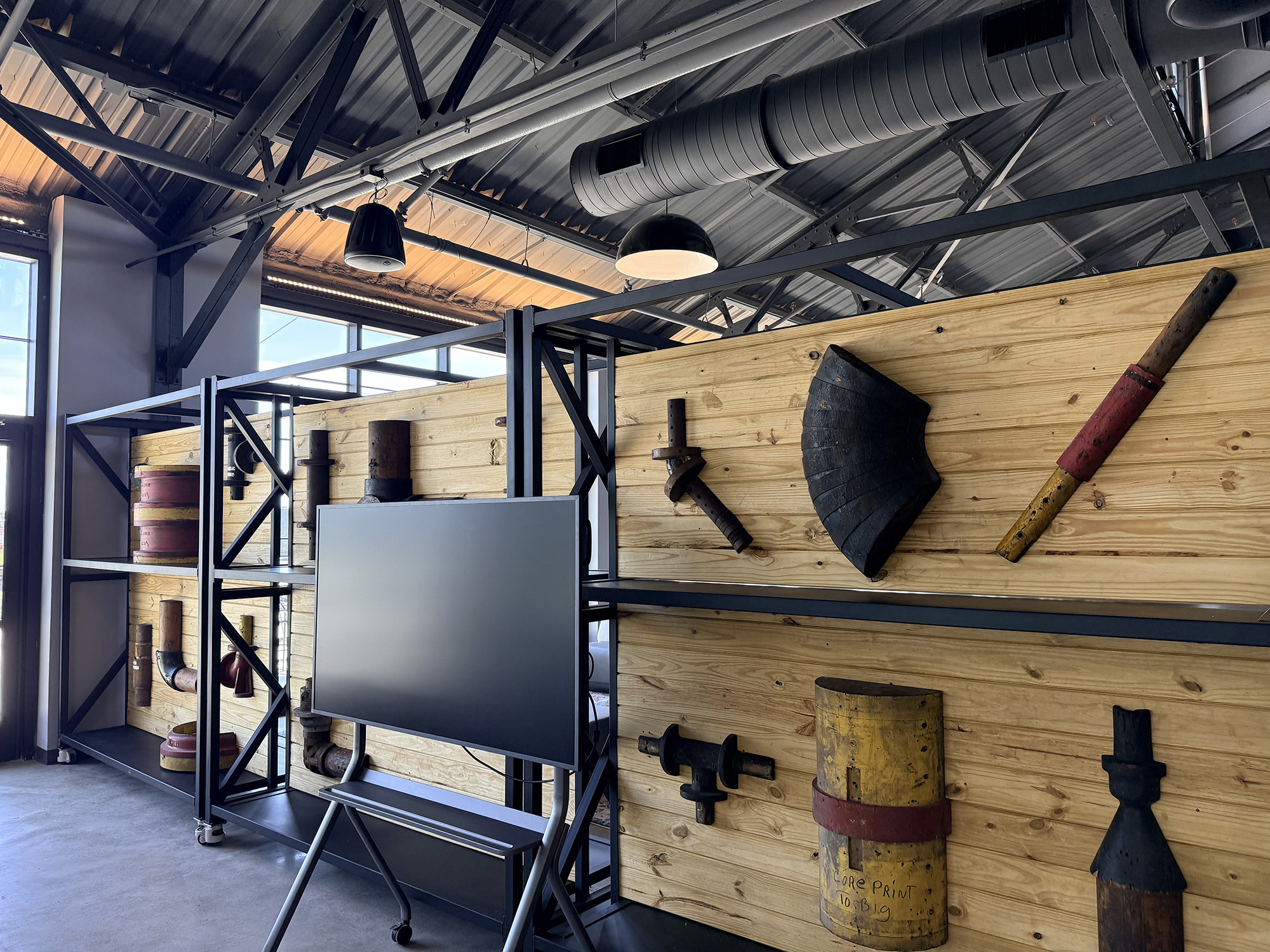
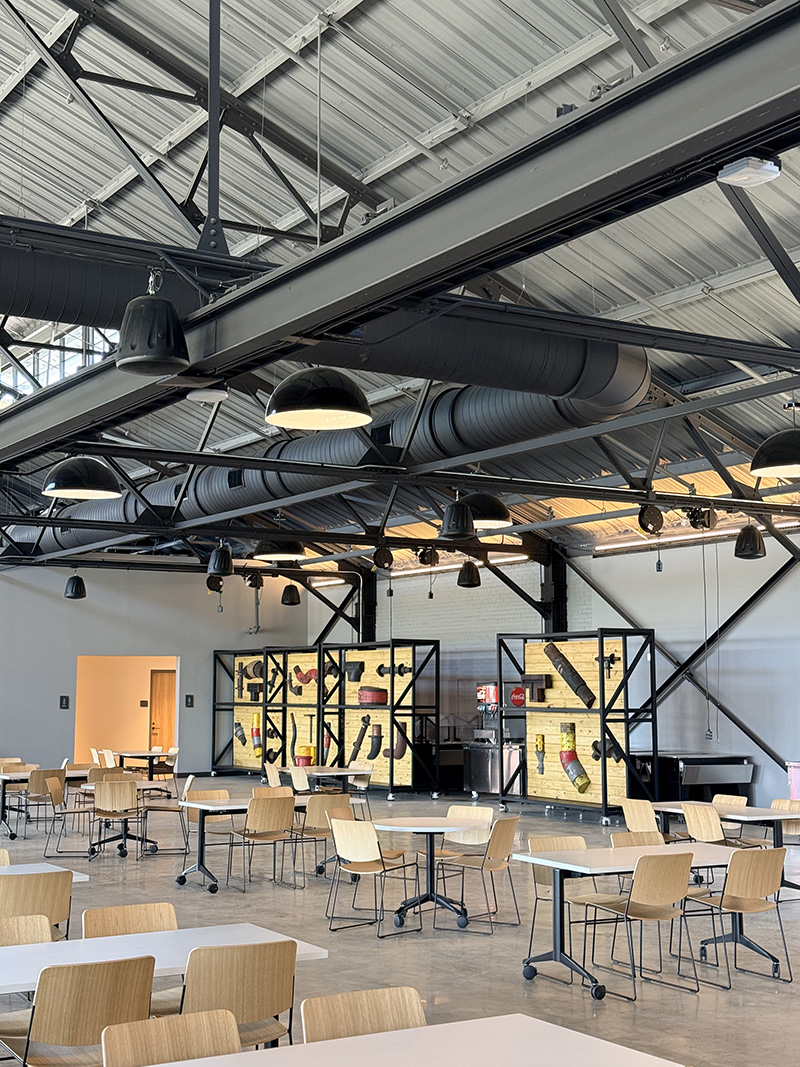
The third historic foundry building incorporated into the ballpark, however, is the real showcase of the merger of old and new: the Coca-Cola Pattern Shop (above), where workers fashioned the molds used in the foundry. This space has been turned into a totally configurable group space, with moveable section walls sporting actual old molds used in the past. The walls are adorned with blown-up images of Chattanooga baseball history and ballparks, including MiLB and Negro Leagues teams. When the foundry shut down, plenty of old molds were left behind—really, they served little use outside a foundry complex—but now they see new life as reminders of the area’s industrial past through the large, 24,000-square-foot space (17,000+ square feet of indoor space, and 7,000 square feet of exterior space).
Both the Coca-Cola Pattern Shop and EPB Powerhouse are being marketed as meeting and event spaces outside of baseball games. With the Coca-Cola Pattern Shop being totally convertible with moveable partitions, it’s suitable for any sort of event—corporate retreats, company gatherings and event receptions.
Two other reminders of Lookouts history: giant Coca-Cola bottles once installed at Engel Stadium, now placed on the outdoor deck seating.
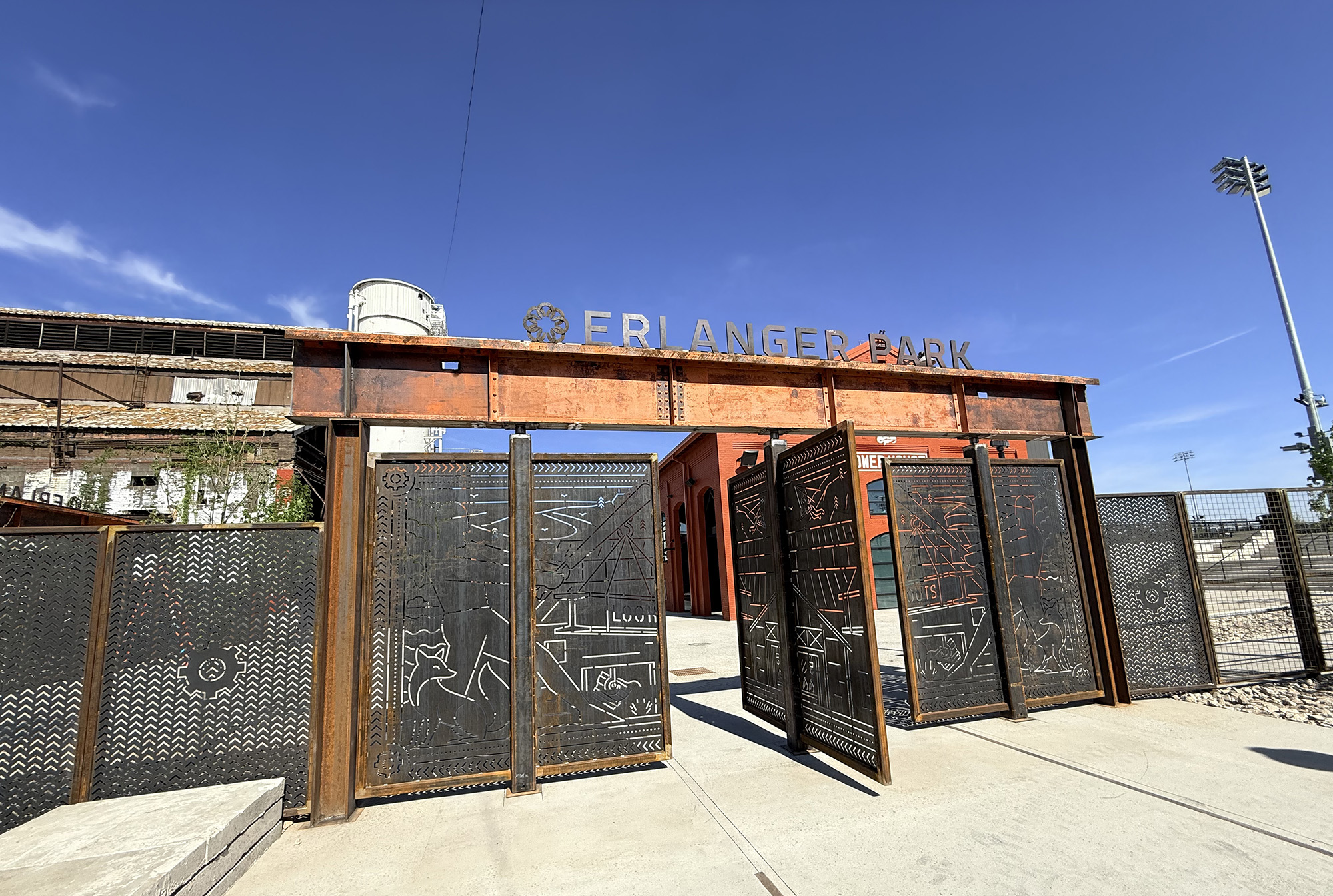
Most of the fans will enter the ballpark from three gates connecting lots from the north. These gates are adorned with three striking, custom screens designed by local artist Tommy Bronx to honor various aspects of Chattanooga history, as you can tell from the three titles: “Where the Game Begins,” “Forged on this Ground,” and “At the Foot of the Mountain.” As you would expect, the screens are fashioned from steel—Corten steel, to be specific, designed to take on a weathered, rustic look. (Yes, this fits directly into the ballpark ethos.) We had mentioned the Tennessee Riverwalk earlier, which will double as a walkway into the park while accommodating bikers and pedestrians the rest of the time. The pathway is adorned with plenty of plantings of native plants and trees.
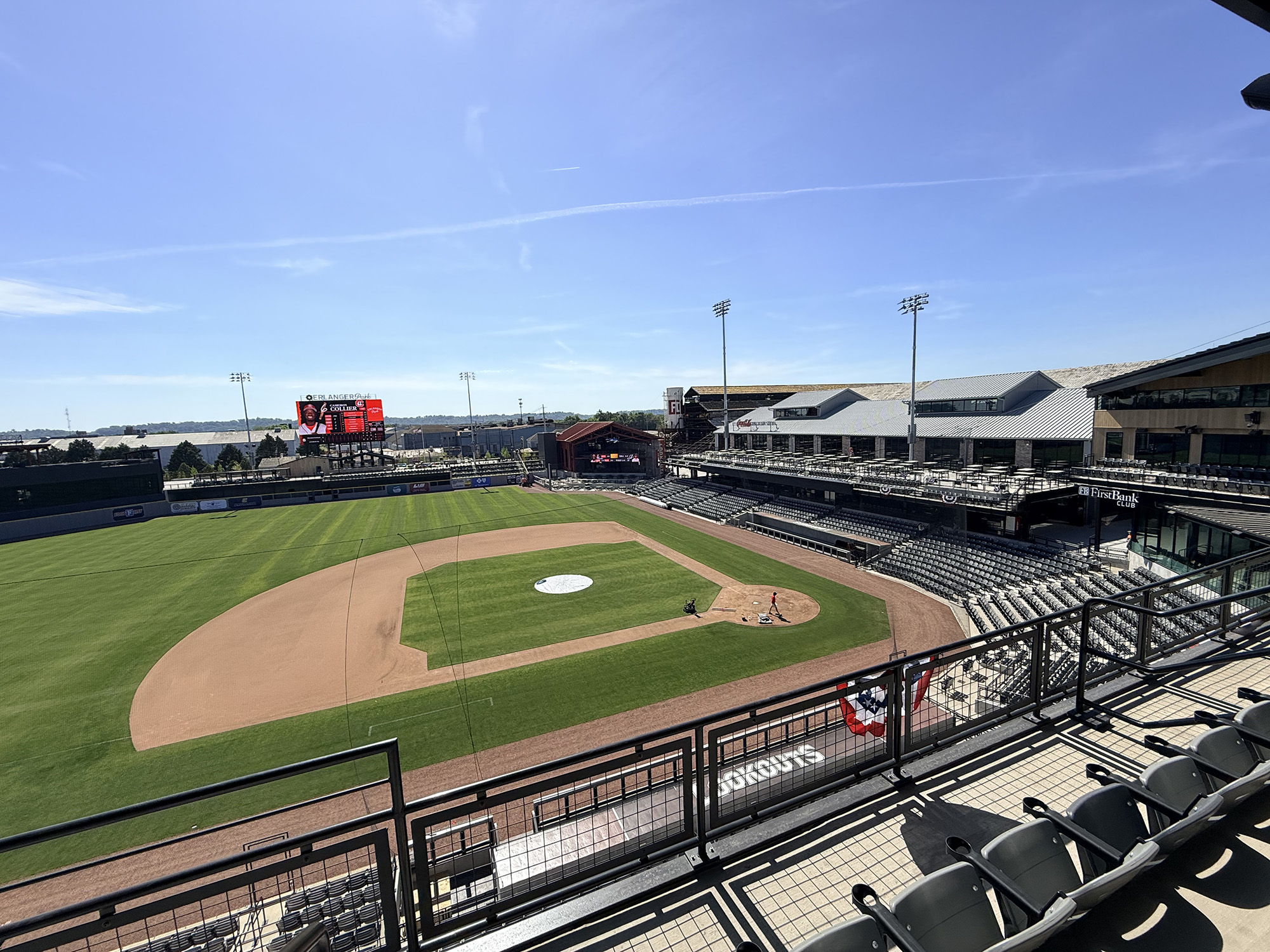
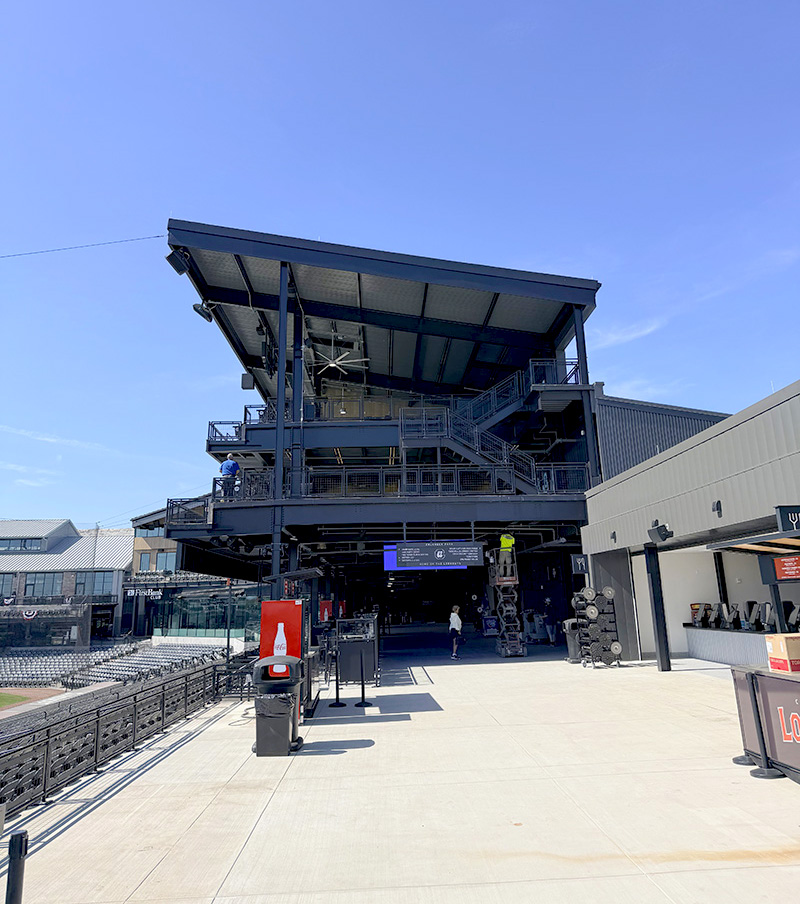
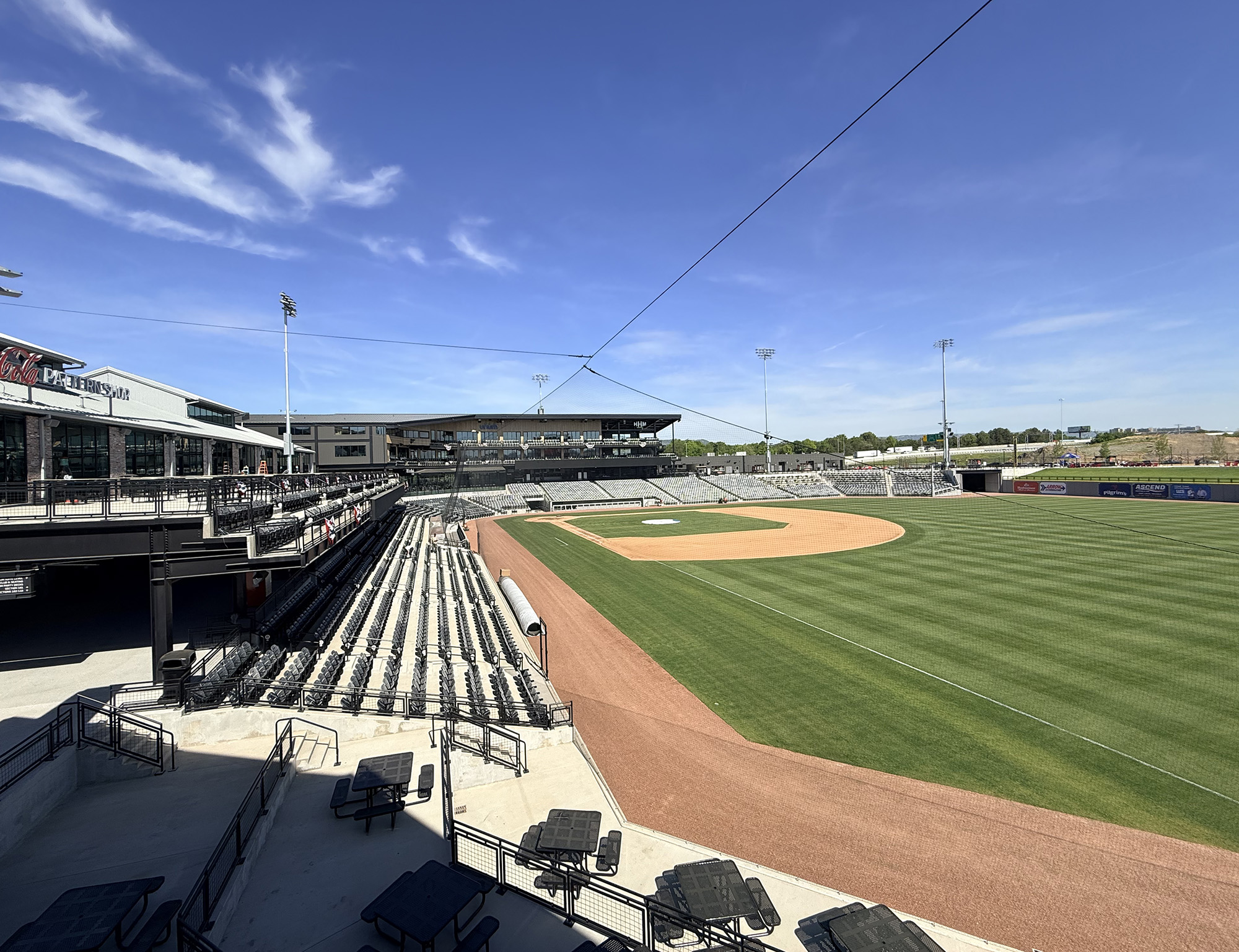
Once you move past the old foundry elements, the remaining ballpark footprint sports a functional modern design. The third-base side of the grandstand, featuring two levels of suites, is totally new construction, connected to the rest of the ballpark via the 360-degree concourse. Because of the unusual properties of the ballpark site, the third-base side of the concourse sits higher than the first-base side, leading to a sloped walkway between the sections.
That new construction also contains everything you’d want in a modern ballpark, including a large commissary and plenty of storage space.
The two different designs also make for a very asymmetric seating bowl, with a deeper third-base side. On the first-base side, only six rows sit between the dugout and the back of the concourse. But there is plenty of additional seating on the concourse in the form of mini-suites, separated by glass partitions, as well as an indoor bar/seating space for the air-conditioned club seating behind home plate.
This all fits within the ballpark ethos found in both Fort Wayne and Columbia: To create a multitude of discrete seating areas throughout the ballpark. From the configurable group spaces in the Coca-Cola Pattern Shop to the expanse of differently sized tables in each corner to the third-base suites to the cabanas in right-center field to the grandstand seating to the large expanse of berm seating in left, there’s a wide variety of seating options at a wide variety of price points.
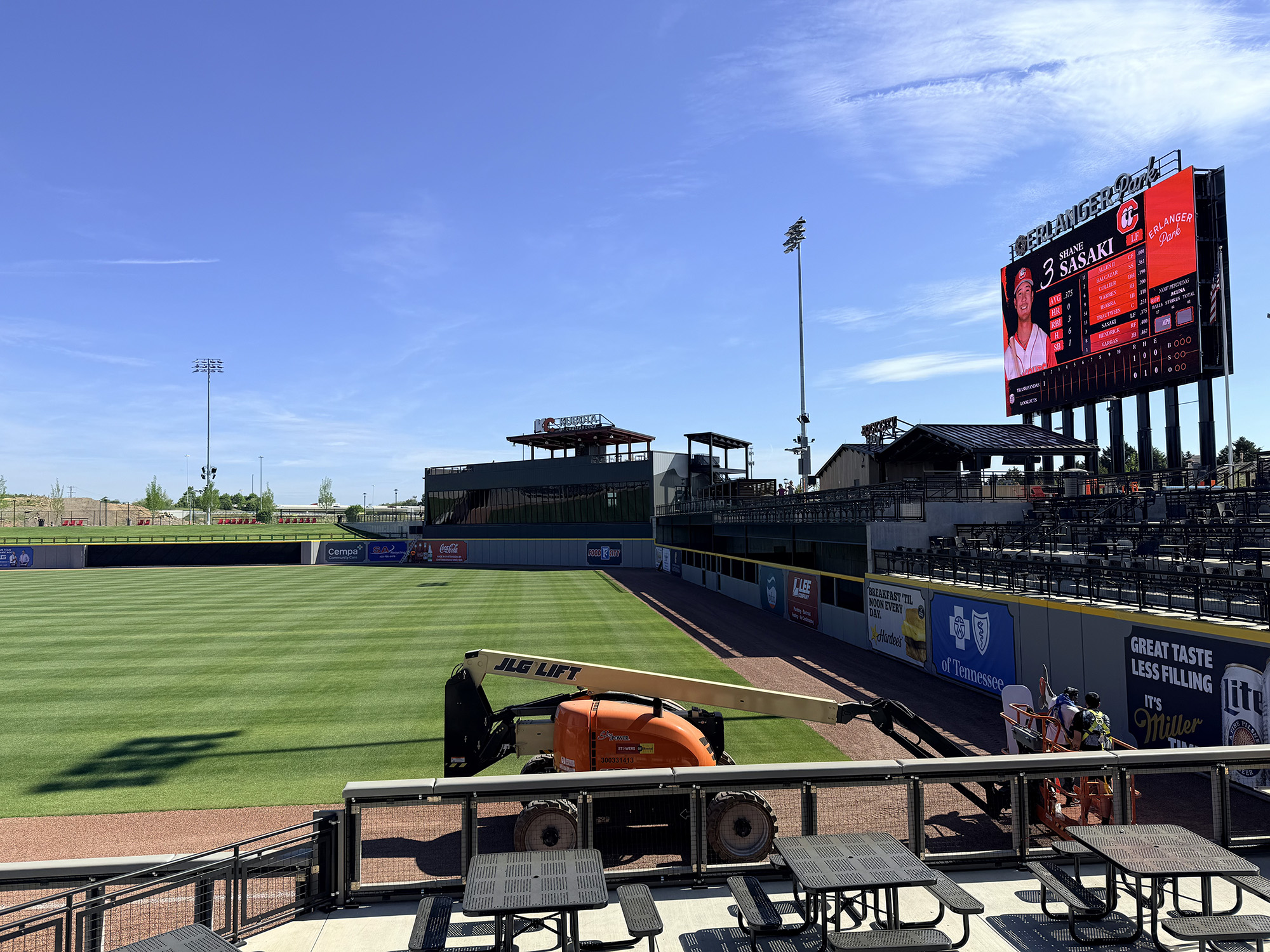
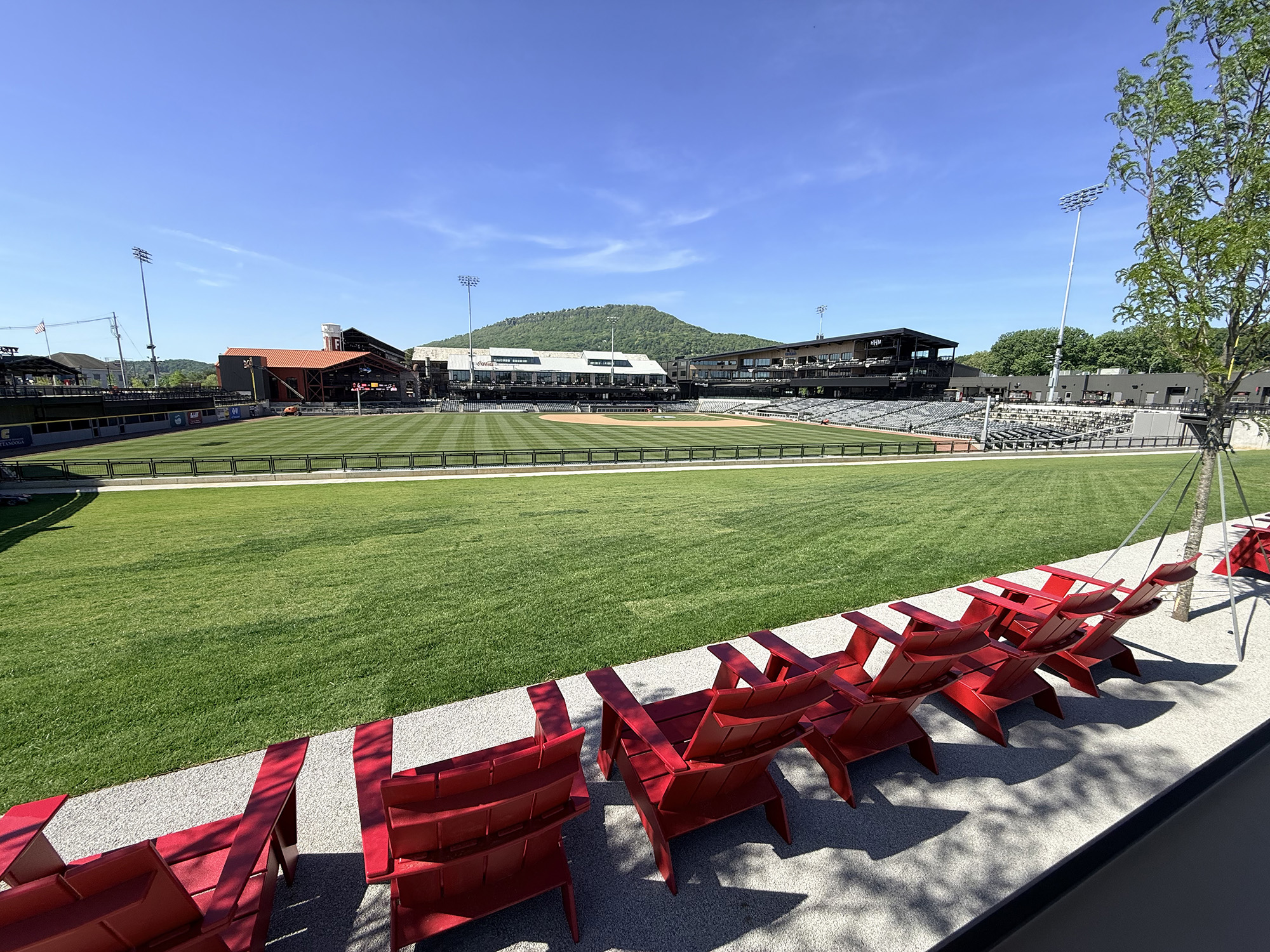
That’s true also of outfield seating, where fans will find a large berm in left field—conveniently located next to the kids’ play area—the main ballpark videoboard, a bar adorned with a “See Rock City” roof and cabanas in right field. (Local vendors are represented at the ballpark; Chattanooga’s Plainview LED supplied the pictured videoboard above.)
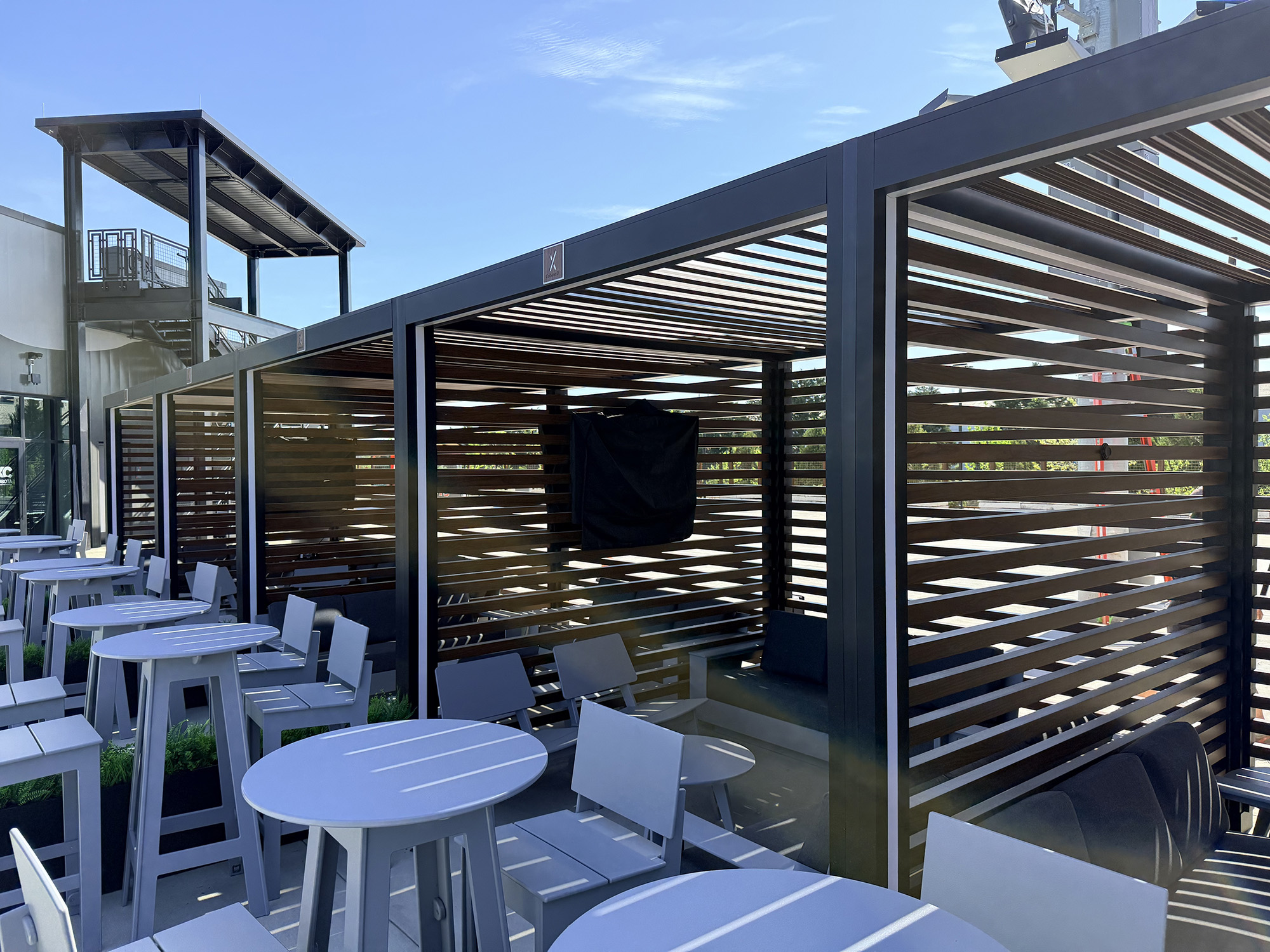
The shaded 10-seat cabanas are a unique seating area within the ballpark, with bar and food service included. The berm features a great view of the grandstand with Lookout Mountain—the first time in Lookouts history that baseball fans would have a view of the venerable landmark from a ballpark, Frier was proud to note. The Rock City Barn is the place to chill, complete with couches, games and a more casual seating arrangement.
Rock City is a reference that will make total sense for Southerners—particularly Chattanoogans—but mean absolutely nothing to Northerners. Rock City was a roadside attraction opening in 1932, located on Lookout Mountain and featuring 400 species of shrubs and wildflowers designed by Garnet and Frieda Utermoehlen Carter. (Garnet Garner was one of the more colorful entrepreneurs of the era; he is credited as one of the inventors of minigolf when he opened “Tom Thumb Golf” on Lookout Mountain.) Opened at the dawn of America’s love affair with automotive tourism, the Carters teamed with local advertising whiz Clark Byers to use the emerging highway system to promote a roadside attraction. In exchange for a free paint job, farmers agreed to sport a large “See Rock City” logo on their barns. There used to be almost 900 barns across the middle of the country with the Rock City logo, but today only 60 or so remain.
The ballpark is the main use for the site, but other structures at the old foundry are slated for redevelopment, while new construction is planned as well. A brewpub, Creature Comforts, is slated to open in reclaimed space inside The Shed next to the ballpark. Beyond left field will sit a six-story, 300-unit apartment building—the kind of apartment building popping up throughout the South Broad Street District. Planning continues on a 80,000-square-foot office building adjacent to the ballpark. Another huge foundry storage space is being evaluated for redevelopment, perhaps as a hotel. All in all, $300 million in private investments is expected to the South Broad Street District thanks to the ballpark. We suspect the area around Erlanger Park of 2036 will look much different than the Erlanger Park of 2026.
Earlier we discussed Engel Stadium opening in 1930 as home of the Lookouts. It still stands, but it’s disused and quietly decaying, subject to reuse plans that never seem to go anywhere. It’s a tremendous piece of baseball history, as documented here by Mark McCarter, who is working on a bio of Joe Engel for a 2027 publication. In an eerie kind of way, the ruins of Engel Stadium resemble the remains of the Wheland Foundry: both proud remnants of a glorious past in Chattanooga history.
The biggest question for us, though, is where Erlanger Park fits within the Minor League Baseball world. The answer is pretty obvious: this is the most striking, fully realized ballpark in MiLB today, certainly best in class. It sets a high bar for any ballparks of the future–even if there are so few planned–and provides a fan experience on an MLB level.
FAST FACTS
Address: 2658 Pipe Way, Chattanooga, TN 37408
Phone: 423/267-2208
Dimensions: 325 LF, 400 CF; 325 RF
Capacity: 8,032