
Baseball and football share a common venue heritage, with pro ballparks hosting bowl games since the 1960s. This year sees five college bowls in past and present MLB and MiLB venues.
College bowls have been around since 1902, when the first Rose Bowl was played at Pasadena’s Tournament Park between the University of Michigan and Stanford, a game convincingly won by the Wolverines, 49–0, after Stanford conceded in the fourth quarter. It wasn’t a huge financial success and wasn’t held again until 1916, when a revival based on civic boosterism and tourism was successful to the point where Pasadena built the Rose Bowl to host the 1923 game. When built, the Rose Bowl was the largest football stadium in the country, reaching a peak capacity of 104,091 in 1972.
The Rose Bowl game was an unqualified success, drawing capacity crowds in the 1920s and 1930s, attracting attention from civic boosters in other warm weather climes seeking to replicate that success. We saw J. Curtis Sanford launch the Cotton Bowl in 1937, while 1935 saw the introduction of the Sun Bowl (El Paso), Sugar Bowl (New Orleans) and the Orange Bowl (Miami), with many cities committing to larger football venues to host the big events.
As multipurpose venues emerged in the 1960s—as well as increased interest in college football thanks to television—we saw a slew of new college bowls played in venues like San Diego Stadium, with the Holiday Bowl launching in 1978, the Peach Bowl played at Atlanta-Fulton County Stadium beginning in 1971, the Bluebonnet Bowl played at the Astrodome in 1968-1984 and 1987, and the Gotham Bowl played at the Polo Grounds in 1961 and the original Yankee Stadium in 1962. (Ironically, the Polo Grounds was a mecca for high-profile college football games for decades but only hosted the one Bowl game, drawing a crowd of just 15,123.) The NCAA kept tight control of college bowls in those days; when the Gotham Bowl attracted a small crowd (6,166) in 1962, the NCAA refused to sanction future editions, leaving just nine bowl games on the docket for 1963.
Then came ESPN.
With the need to constantly feed the beast, ESPN stepped in as an organizer of an expanded bowl slate in the 2000s, expanding on the groundbreaking football-broadcasting path taken by Raycom Media in the 1970s and 1980s. (Many of the smaller bowl games are organized by ESPN Events, including the Fenway Bowl and the Salute to Veterans Bowl.) Take 2017, when we wrote about bowl games in baseball facilities. Yankee Stadium hosted the Pinstripe Bowl, Chase Field hosted the Cactus Bowl (formerly the Copper Bowl), and Tropicana Field hosted the Gasparilla Bowl (formerly the St. Petersburg Bowl). In that time Petco Park hosted the Holiday Bowl and Oracle Park hosting a series of bowl games (San Francisco Bowl, Emerald Bowl, etc.) as well.
This year sees three MLB ballparks hosting college bowl games and two stadiums with MiLB lineage hosting bowl games as well. The aforementioned Pinstripe Bowl is set once again for Yankee Stadium on Dec. 27, with the Penn State Nittany Lions taking on the Clemson Tigers. In Boston, the 2025 Fenway Bowl features an Army Black Knights–UConn Huskies game on Dec. 27. And in Phoenix, the University of Minnesota Golden Gophers will square off in Chase Field against the New Mexico Lobos on Dec. 26 in the Rate Bowl (formerly the Cactus Bowl/Copper Bowl).
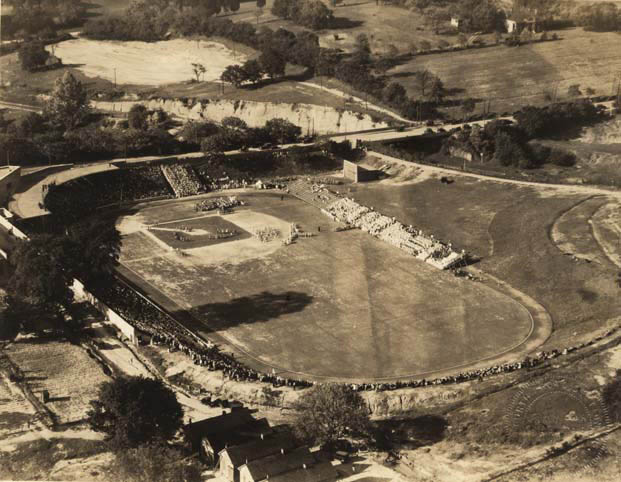
We’re descending into trivia when noting the MiLB connections to two bowl venues. The first: the Dec. 16 Salute to Veterans Bowl at Montgomery’s Cramton Bowl, featuring Troy vs. Jacksonville State. Opening in 1922, the Cramton Bowl hosted Minor League Baseball (Montgomery Lions, Montgomery Rebels), MLB Philadelphia Athletics spring training, Negro Leagues games (including the eighth game of the 1943 Negro World Series) and college football (including a decade hosting the Alabama Crimson Tide). But the stadium fell into disrepair by the turn of the century, and the city of Montgomery spent $10 million on a renovation that set capacity at 25,000 and firmly established Cramton Bowl as a football venue, with a 2012 opening. While naming rights to college bowls are a necessary evil, this game has a more lyrical history, launching in 2014 as the Camellia Bowl.
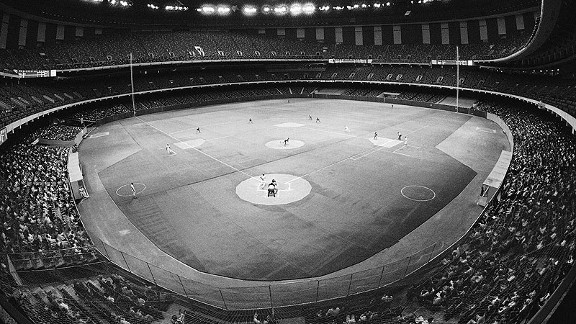
The second is pure trivia: the Caesars Superdome hosting the Allstate Sugar Bowl on New Year’s Day. When opening in 1975, the Superdome was designed as a multiuse venue for both baseball and football, with the hopes that an MLB team would show interest in New Orleans. (Indeed, there was talk that at one point the Minnesota Twins were sniffing around regarding a potential move.) There were MLB exhibitions played at the Superdome (including a 1976 Twins-Astros game shown in the top photo), and in 1977 the minor-league New Orleans Pelicans called the Superdome home. But no MLB relocated, the Superdome was an awfully large venue for Minor League Baseball, and future renovations removed the baseball functionality, leaving the Superdome as a football-forward facility.
Cramton Bowl photo courtesy U.S. Army Air Service, Alabama Department of Archives and History.