With his purchase of the Los Angeles Angels, Stan Kroenke enters Major League Baseball with a proven record both as a team operator and real-estate developer—putting the future of Angel Stadium in play.
Kroenke’s track record as a sports entrepreneur is well-documented as owner of the Los Angeles Rams (NFL), Colorado Rapids (MLS), Denver Nuggets (NBA), Colorado Avalanche (NHL), Colorado Rapids (MLS) and Arsenal Football Club (Premier League). His sports-development/real-estate experience is also extensive: His companies built and runs SoFi Stadium, home of the Rams; the 300-acre Hollywood Park development in Inglewood; and Dick’s Sporting Goods Park, home of the Rapids. His firm runs Ball Arena, home of the Nuggets and Avalanche. Kroenke also owns Altitude Sports & Entertainment, which broadcasts Nuggets and Avalanche games, and the Outdoor Sportsman Group, which operates a variety of cable and publishing brands, including the Outdoor Channel and In-Fisherman.
In a way, owning an MLB team is a role Enos Stanley Kroenke was born to play; the Columbia, MO native was named for Cardinals legends Enos Slaughter and Stan Musial. The purchase price of a controlling interest in the Angels and its broadcast outlets from Arte Moreno by Kroenke Sports & Entertainment was not disclosed, but it’s widely being reported as based on a valuation of $4 billion—beating out the record price of $3.9 billion paid by José E. Feliciano and Kwanza Jones for the San Diego Padres. (It may or may not be a record; the purchase also includes a stake in the Angels’ regional television network and radio station, Angels Broadcast Television [ABTV], while the Padres sale didn’t include any broadcast assets.) Angels owner Arte Moreno will maintain a minority share in the team.
“The Angels are a storied franchise anchored in a great market,” Kroenke said via press release. “We look forward to an exciting future with the Angels organization.”
The sale, which is expected to close by the beginning of the 2027 MLB season, marks the end of the Moreno ownership era, which began in 2003 when he bought the Angels from Walt Disney Corp. Moreno was no stranger to baseball, having invested in MiLB teams in the past (including the legendary Salt Lake Trappers), and as the first Latino MLB team owner, he made history in a sport that prides itself on history. He began his ownership tenure with a bang, securing fan support after lowering beer prices, signing high-profile free agents like Vladimir Guerrero and crafting a roster that won the American League West five times between 2004 and 2009.
But that stretch ended, with the team making the playoffs only once since 2010 and attendance at Angel Stadium declining. The team has staggered through several different front-office staffings and player-development strategies, currently mired in last place in the American League standings with a 53-87 record.
While Moreno had explored selling the team several times over the past several years, he approached that task like he did player-development strategies: lurching from plan to plan. And he’s lurched between strategies to address the condition of the rapidly aging Angel Stadium, the fourth-oldest ballpark in Major League Baseball after Wrigley Field, Fenway Park and Dodger Stadium.
Enter Kroenke, one of the most successful sports entrepreneurs of our time. There are several reasons for Angels fans to be excited about the purchase, but prime among them is his track record as an owner: his teams win. The Rams, Arsenal, Nuggets and Avalanche have all won championships over the last five years, and when they’re not winning it all they are annually competitive. He’ll pay competitive salaries; his Nuggets, for example, had the NBA’s second-highest payroll ($226.68 million) entering the 2026-2027 season.
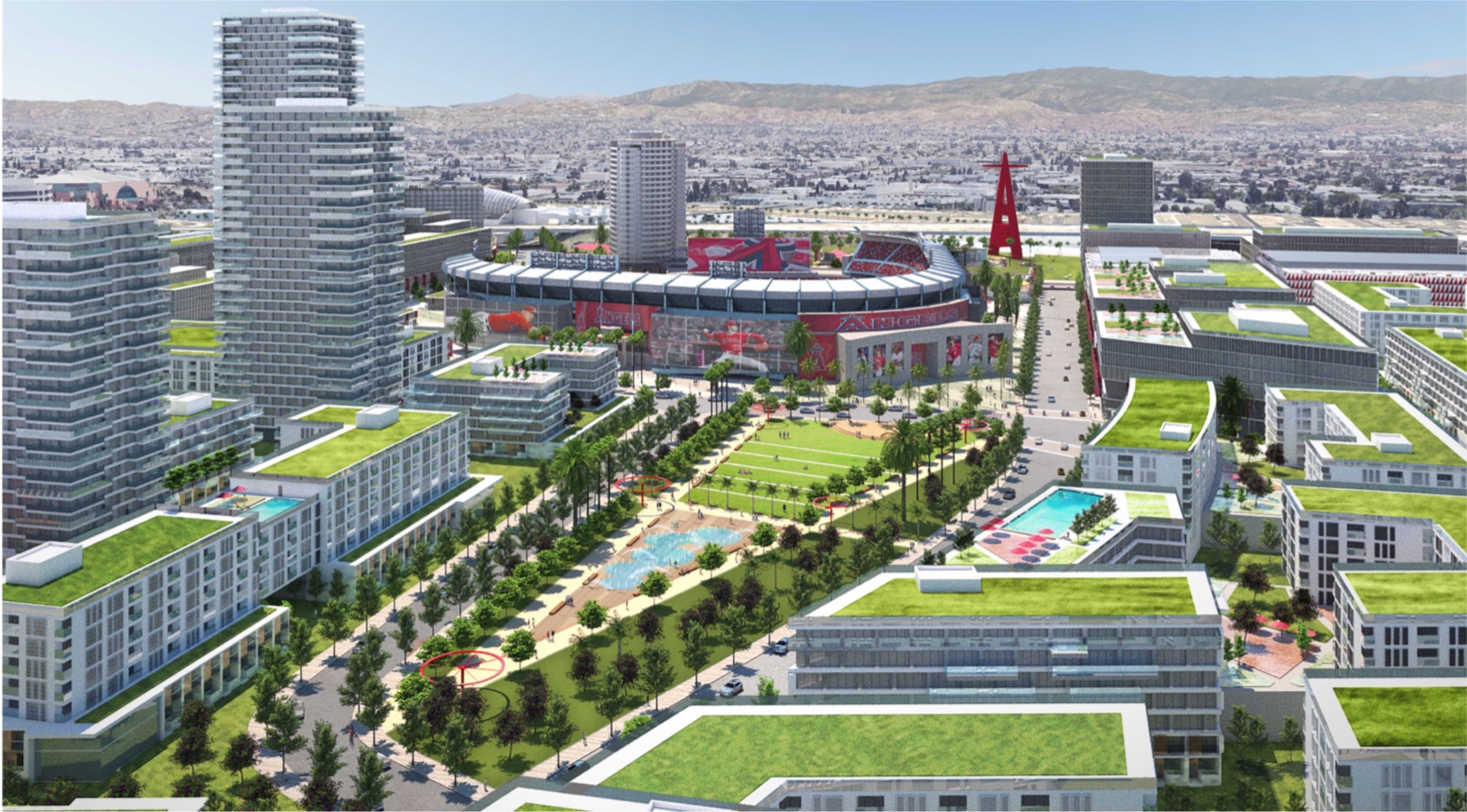
For us, however, the big issue will be how Kroenke approaches the future of Angel Stadium and the potential development potential in the surrounding land. Earlier this decade Moreno had come to agreement with Anaheim on a development plan that called for a renovation of Angel Stadium as part of the sale of the ballpark and surrounding land, but that plan crumbled after the emergence of an FBI investigation into corruption involving former Mayor Harry Sidhu. The plan called for the $320-million sale of the 20-acre Angel Stadium site and an additional 133 acres comprising 12,500 parking spaces for games and events, and City National Grove of Anaheim, a 1,700-seat theater, to SRB Management, which included Moreno and partners.
For Kroenke, we’re guessing access to 150 acres of developable land in a solid suburb like Anaheim is a very key part of this deal. It’s been reported—though not in mainstream media outlets like the Los Angeles Times and The New York Times—that Kroenke would be tearing down Angel Stadium and building a new ballpark. While that certainly was a premature conclusion, it would make sense to center a new sports and entertainment district around a new ballpark.
Angel Stadium opened April 19, 1966 with Gene Autry as team owner. At a time when Shea Stadium and the Astrodome represented the cutting edge of ballpark design, Anaheim Stadium was in a sense an old-fashioned ballpark before retro was cool. No roof, no circular design: just a boomerang grandstand owing more to Yankee Stadium than Shea Stadium. Built by Del Webb and designed by Noble Herzberg, who also worked on D.C. Stadium and later Royals Stadium and had experience with Webb on previous Yankee Stadium renovations, Anaheim Stadium was old when it opened. It was renovated twice since that opening, the first time enclosed to add enough seats for Los Angeles Rams football and later opened up for baseball by Robert A.M. Stern and Populous under Disney leadership. But its condition has deteriorated over the years, and it will certainly need plenty of TLC.
And it may have been a telling detail toward what Kroenke sees as the future of the team in the press release announcing the sale: the first reference to the team was the Los Angeles Angels of Anaheim, a moniker that is still the team’s legal name but largely eschewed in recent years. Anaheim officials were reportedly excited about the sale of the team and the potential redevelopment of the Angel Stadium site. Earlier this year the California Legislature passed the “Home Run for Anaheim Act,” which provides the city with an incentive to making a deal with the Angels ownership on development: If the city obtains a waiver from a state requirement to prioritize affordable housing in a mixed-use development that includes Angel Stadium or a new ballpark, then the team must be called the Anaheim Angels.
We’re not quite sure Arte Moreno ever realized how much he pissed off Anaheim elected officials and citizens with the awkward name change to Los Angeles Angels of Anaheim, later omitting the Anaheim reference. So there are some bridges to be repaired. While Kroenke certainly knows how make an aggressive exit—just ask St. Louis officials—he will be walking into the owner’s office with a clean slate.
Rendering of potential Angel Stadium redevelopment from 2023, courtesy Los Angeles Angels.