
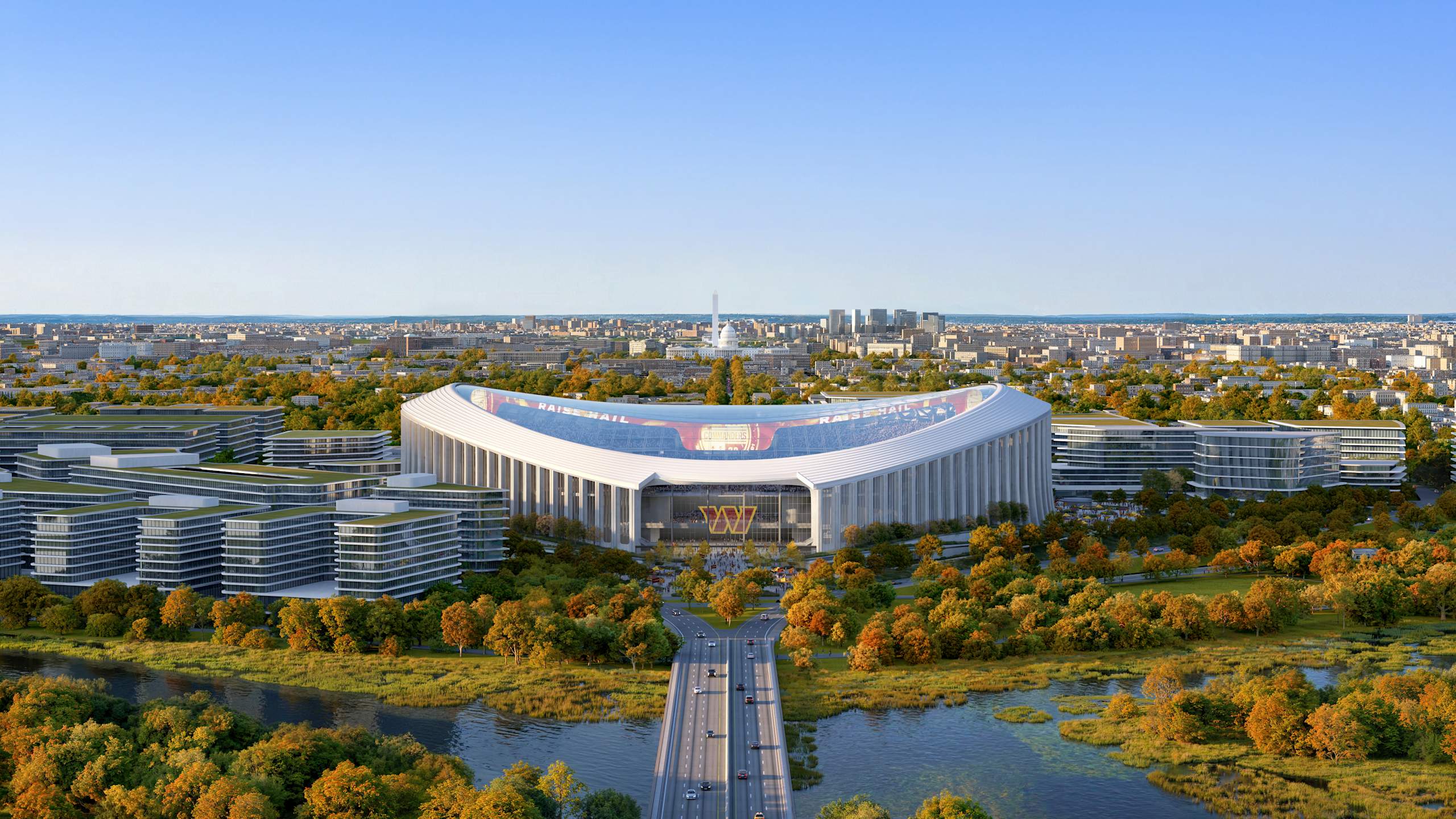
A proposed new Washington Commanders stadium will feature homages to the site’s previous resident, RFK Stadium, while featuring enough classical colonnades for those wanting to mandate a traditional design for the NFL facility.
While the curved roofline isn’t an exact replica of the distinctive RFK Stadium design—technically, it’s an anticlastic (“potato chip”) curvature, originally used in the sports world back in the 1950s in facilities like Raleigh’s Dorton Arena, before the invention of Pringles—it certainly provides a more elegant approach to design and site context than did initial renderings. And while there was nothing remotely classical about the original Commanders stadium design, new renderings from the Commanders and architect HKS show a radically altered approach to the 70,000-seat-plus facility. Like RFK Stadium, the new Washington Commanders stadium is aligned with the L’Enfant Plan, and the new stadium will even sit on some of the original RFK Stadium footings at the same Anacostia River site. And, amazingly enough, the new stadium may feature some “bounce seats” to mimic the movable metal seating at RFK Stadium.
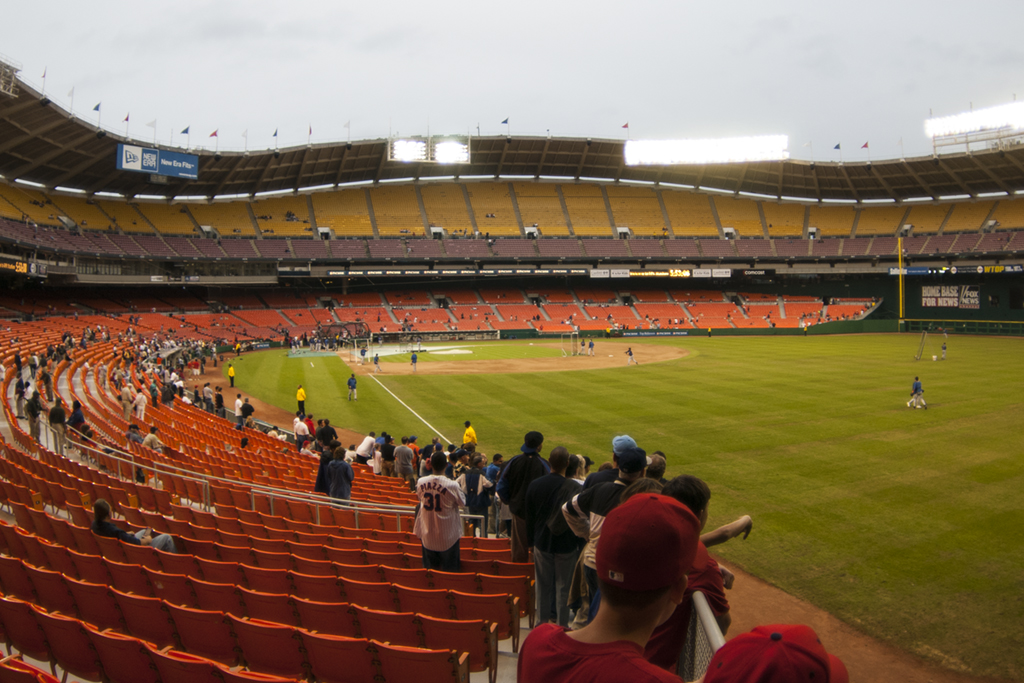
When D.C. Stadium opened in 1961 (it would be renamed Robert F. Kennedy Stadium, or RFK Stadium, in 1969), it was the first multiuse, reconfigurable stadium built explicitly for pro baseball and pro football. In terms of baseball history it was home to the second iteration of the Washington Senators from 1962-1971 and the temporary home of the Washington Nationals (2005–2007) after the team relocated from Montreal.
“Every design decision is guided by the significance of place – shaped by its local, regional and national history and generations of memories rooted in RFK Stadium,” said Mark Williams, HKS Global Venues Director, via press release. “Monumental in presence, grounded in the L’Enfant Plan and scaled to the urban fabric of the District, the stadium design will be a bold civic landmark that carries the city’s architectural legacy forward in a way that is confident, dynamic and unmistakably Washington, DC.”
But unlike RFK Stadium, it will be covered and allow for 200-plus events a year, including Super Bowls and Final Fours, thanks to a transparent top suspended by cables. (It will also allow noise levels to approach those experienced at Redskins games at RFK Stadium.) As opposed to RFK Stadium, where the entrance faced the west (allowing for views of the U.S. Capitol and the Washington Monument), the new stadium will feature an entrance facing the East and the Anacostia River. And unlike RFK Stadium, the Commanders and the District of Columbia are taking a more holistic approach to the site; instead of being surrounded by a sea of concrete parking, the area will feature new development combined with new outdoor plazas, public spaces and green areas. The team says 30 percent of the site will be dedicated to active and passive recreation.
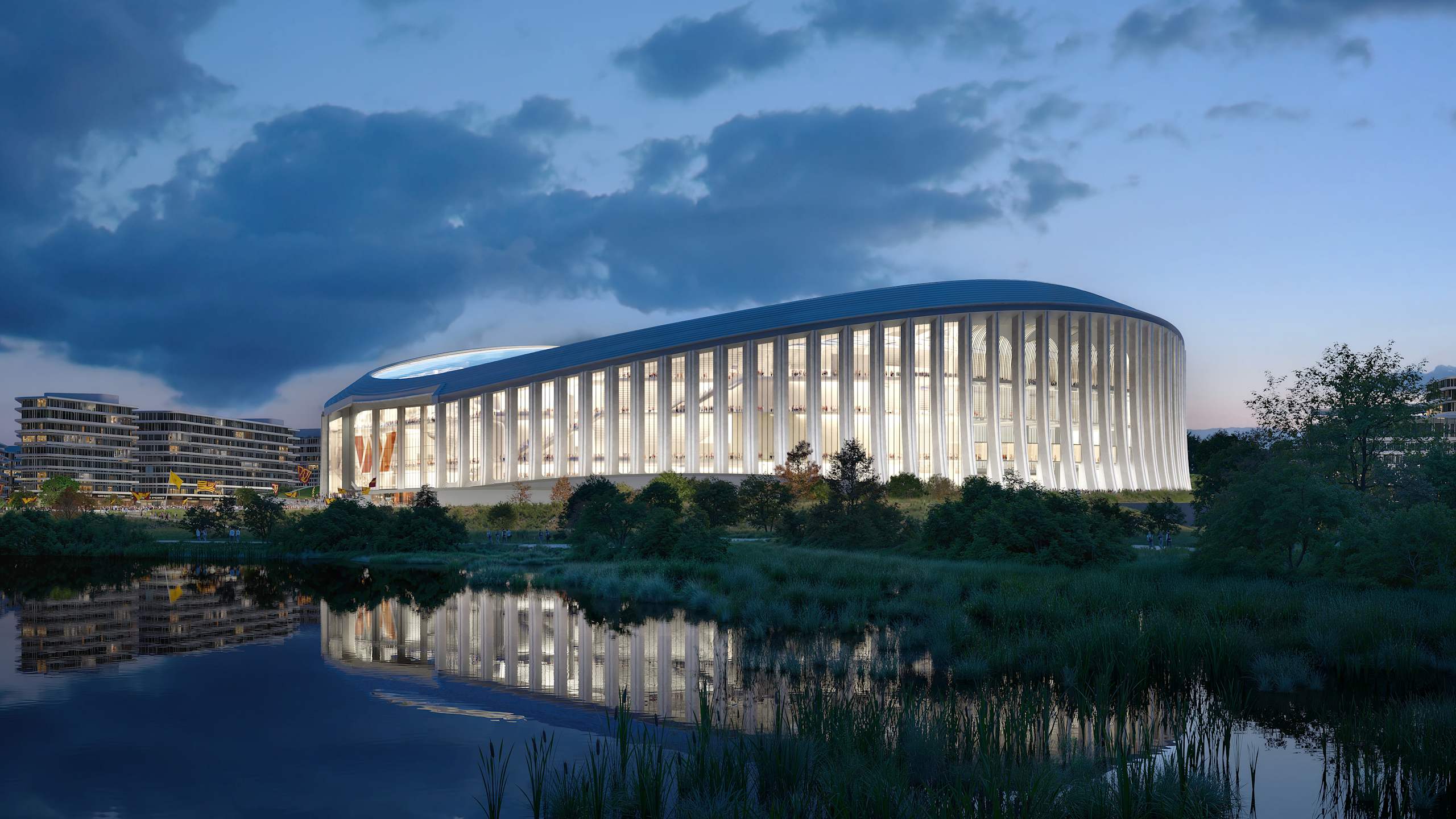
And, with inclusion of weight-bearing colonnades combined with plenty of glass panels (as opposed to decorative, functionally meaningless columns), the design of the new Washington Commanders stadium should appeal to traditionalists who current have a heavy say in District of Columbia design decisions. As you might expect, there are a number of district and federal boards with some level of say in the design, including the District of Columbia itself, the National Capital Planning Commission and the U.S. Commission of Fine Arts.
“We are proud to share the first visuals of our future stadium, a defining milestone in the next phase of the development process,” said Mark Clouse, president of the Washington Commanders, via press release. “This moment underscores the strength of our partnership with HKS, whose thoughtful, forward-looking approach has helped us shape a concept that is worthy of its extraordinary site along DC’s Monumental Axis and truly embodies the spirit and character of the District. We are deeply grateful to the District and the Mayor for their leadership, collaboration, and continued support, which have been instrumental in bringing this vision to life.
“From the beginning, our focus has been on delivering a best-in-class experience for Commanders fans while honoring the legacy of RFK Stadium and our team,” Clouse added. “We’re designing a stadium that amplifies the energy of football, supports year-round events and becomes a place the community can be proud of. We look forward to hearing feedback from our community as the design continues to evolve.”

HKS has a track record of designing site-specific cutting-edge NFL stadiums, including AT&T Stadium (home of the Dallas Cowboys), U.S. Bank Stadium (home of the Minnesota Vikings) and SoFi Stadium (home of the Los Angeles Chargers and Los Angeles Rams).
The timeline: If design goes well, construction on the new Washington Commanders stadium could begin in 2027, with the stadium, team offices and parking facility open for the 2030 NFL season.
Renderings courtesy Washington Commanders.
RELATED STORIES: New Washington Commanders stadium on tap for RFK Stadium site; Next stage of RFK Stadium demolition to proceed; RFK Stadium demolition underway; RFK Stadium seats to go on sale; End of an Era at RFK Stadium; RFK Stadium future subject of meetings; RFK at 50: Will there be 50 more?; Are final days near for RFK Stadium?