
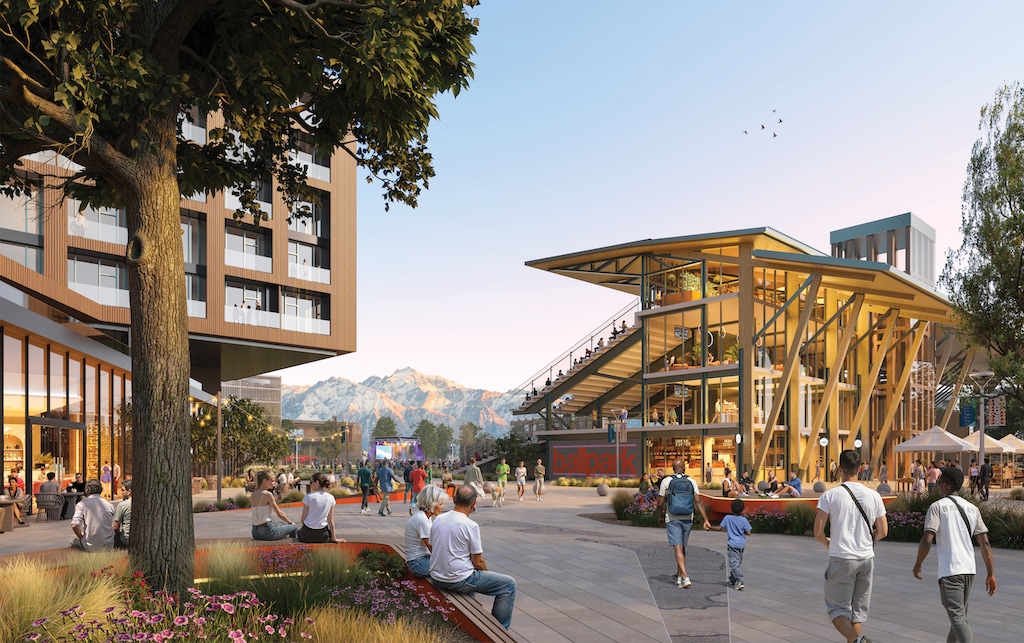
After months of study and debate, Salt Lake City approved a Smith’s Ballpark adaptive reuse plan that will see the former Salt Lake Bees (Class AAA; Pacific Coast League) home converted to residential, possible private development and an entertainment venue.
The 15-acre Smith’s Ballpark site was rendered as obsolete after the Bees’ move to a new South Jordan ballpark after the 2024 season and the temporary use of the facility by the University of Utah college baseball team in 2025. Public input was solicited, and while a popular vote saw sentiment for an emphasis on women’s sports, but the Salt Lake City’s Redevelopment Agency (RDA) Board of Directors commissioned Perkins&Will to review three urban design scenarios for redeveloping the Smith’s Ballpark site on Tuesday. The three scenarios focused on sports, culture–which stresses Smith’s Ballpark adaptive reuse–or ecology, with housing a potential use across all three.
In the end, a hybrid approach won out. Portions of the ballpark will be retained as an entertainment venue, while the city will seek out development partners to add housing and more to the 14+-acre site. The neighborhood surrounding the ballpark isn’t the best part of town, and Salt Lake City officials see redevelopment of the site as a way to transform the neighborhood.
There is one drawback: it will be a number of years before enough changes can be made to impact the neighborhood. SLC officials estimate that results from a Smith’s Ballpark adaptive reuse plan will be seen in five years; development takes time, and transformation development takes longer. From the Salt Lake Tribune:
That longer timeline didn’t dampen optimism at Tuesday’s vote about the plan’s ultimate ability to lift the fortunes of the south central Ballpark neighborhood after the Bees’ 2024 departure for a fresh stadium in South Jordan’s Daybreak.
In the making for nearly three years, the city’s finalized blueprint will now be used as a guide for road and other infrastructure work in the neighborhood, as well as efforts to attract interest in redevelopment of portions of the site from the private sector….
A salvaged and revamped central portion of the stadium structure and a saved portion of the ballfield would together span up to about 20,000 square feet. The multipurpose venue would offer up to 9,000 spectators large concerts and smaller community events.
Redeveloping old ballparks is a challenge. There have been some successful redevelopments, such as the conversion of Indianapolis’s Bush Stadium to housing, but cities like Columbus and Chattanooga are grappling with the challenges of finding new uses for old ballparks.
Rendering courtesy Salt Lake City.
RELATED STORIES: It’s curtains for Smith’s Ballpark after final game; Smith’s Ballpark adaptive reuse on SLC agenda; Vote on Smith’s Ballpark reuse goes to the She Plays Here proposal; Smith’s Ballpark reuse plan as women’s sports center shows promise; Salt Lake City seeks input on Smith’s Ballpark future